Wood Chunks vs Chips vs Pellets: Which Smoking Wood Format Wins
Three formats of the same material, sold on the same shelf, doing genuinely different jobs. The difference is not flavour, because oak is oak whichever shape you buy it in. The difference is how long one addition burns, and that single variable decides which format belongs in your cooker, how often you open the door, and whether you spend a twelve hour cook tending wood or ignoring it.
That is the short answer, and the rest of this page is the reasoning. If you burn charcoal, buy hardwood chunks and stop thinking about it. If you own a pellet grill, pellets are your fuel as well as your smoke, so the question does not arise. Chips are the format people buy first, use twice and then resent, and there is a specific and narrow case where they are exactly right.
How long does each format actually burn?
This is the spine of the whole comparison, so it is worth being precise about it. A handful of wood chips thrown onto a hot charcoal bed will ignite, flame, and be finished in roughly 20 minutes. That is not a defect, it is geometry: chips have enormous surface area for their mass, so they give up everything they have very quickly. On a six hour rib cook that means eighteen refills, each one costing you an open lid and fifteen minutes of temperature recovery.
A fist-sized chunk has the opposite geometry. Most of its mass is buried under its own surface, so it chars on the outside and smoulders inward, releasing smoke for roughly 45 to 75 minutes depending on how close it sits to the fire and how much air is moving past it. Two chunks buried in an unlit charcoal ring at the start of a cook will ignite at different times as the fire creeps toward them, which spreads smoke across the first several hours without you touching anything.
Pellets break the pattern completely, because you are not choosing an amount at all. An auger feeds a few pellets at a time into a burn pot on a duty cycle set by the controller, which means smoke output is a function of how hard the controller is working rather than of a handful you threw in. That is why pellet grills make the most smoke at their lowest setting: at 180°F the auger burns about 0.6 lb per hour in slow pulses that smoulder, while at 275°F it burns 1.4 lb per hour in a fire hot enough to be nearly smokeless. Turning the temperature down is the pellet grill's smoke knob.
Which format does your cooker take?
Most of the confusion in this category is people using the right wood in the wrong machine.
Charcoal cookers want chunks. Bullets, drums and kettles all burn a bed of charcoal that you can bury wood inside, and burying it is the whole trick: a chunk under unlit briquettes ignites slowly as the fire reaches it rather than flaring on contact. A charcoal bullet running the minion method with two or three chunks buried in the ring produces smoke for hours with no intervention. Chips in the same cooker are a chore with no upside.
Electric cabinets take either, and the door design decides which. A cabinet with a small chip tray sitting on the element is built for chips and will happily take them, though most of them also accept a chunk or two if the tray is deep enough. The feature that matters is a side loader: the Masterbuilt 30 inch digital cabinet lets you push chips in from outside without opening the door, which removes the only real objection to the format. If your cabinet has no loader, use chunks so you are not opening the door every twenty minutes.
Pellet grills take pellets and nothing else. Never pour chips or chunks into a pellet hopper. The auger is sized and geared for a uniform cylinder, and anything else either jams it or feeds erratically, which is a mechanical repair rather than a bad cook. A WiFi pellet grill with a PID controller is metering fuel to the tenth of a pound, and that only works with the format it was designed around.
Offsets burn splits, which are simply chunks scaled up to logs. Everything on this page about chunk geometry applies to a split, just over a longer timescale. The offset fire management guide covers that cooker properly, because on a stick burner the wood is the fire rather than an addition to it.
Chunks vs chips vs pellets, head to head
| Dimension | Wood chunks | Wood chips | Wood pellets |
|---|---|---|---|
| Burn time per addition | 45 to 75 min | About 20 min | Continuous, auger fed |
| Smoke intensity | Strong, arrives in pulses as each piece lights | Short mild bursts, then nothing | Moderate and steady, heaviest at low temperatures |
| Cooker compatibility | Charcoal bullets, drums, kettles, most electric cabinets | Electric cabinets with a chip tray or side loader, gas grills | Pellet grills, plus smoke tubes in any cooker |
| Control over smoke | Coarse: you choose how many pieces and when | Very coarse: refill every 20 minutes or get nothing | Fine: set by grate temperature and controller duty cycle |
| Fuel cost for a 12 hour cook | About $1 to $3 | About $2 to $5 | About $11.55 |
| Storage sensitivity | Low: keep dry and off the ground | Low, though fine pieces mould faster if damp | High: airtight only, damp pellets crumble and jam an auger |
| Ease of use | Add two or three at the start, then ignore | Fiddly, constant refills, repeated door openings | Easiest: fill the hopper and set a temperature |
| Best cooks | Brisket, pork shoulder, beef ribs, anything over 6 hours | Fish, chicken pieces, cheese, anything under 2 hours | Everything on a pellet grill, plus cold smoking in a tube |
| Risk of over-smoking | Moderate: easy to overload a small chamber | Low: they run out before they can do damage | Low on the grill, moderate if a tube runs all day |
The cost row deserves a note, because it is the one people find surprising. At 225°F a pellet grill burns roughly 0.85 lb per hour, so a twelve hour brisket eats about 10.2 lb of pellets. That is real money on every cook, and it is the running cost nobody budgets for when they buy the cooker. Work yours out on the pellet usage calculator before you buy in bulk, and remember that cold and wind push consumption up sharply on an uninsulated grill.
Should you soak wood chips before smoking?
No, and this is the single most repeated piece of bad advice in barbecue. Soaking does not make more smoke. Water does not meaningfully penetrate wood: after an hour in a bucket, a chip is wet on the outer few millimetres and bone dry in the middle, and a chunk is barely wet at all. Wood is built to move water in one direction along the grain and it does not rehydrate on demand.
What soaking actually does is delay combustion. The surface water has to boil off before the wood can reach ignition temperature, and while that is happening you get steam plus the thick white smoke of wood smouldering wet rather than burning cleanly. That white smoke is loaded with unburnt particulates and creosote compounds, which is exactly the flavour people describe as acrid or like an ashtray. It looks like more smoke because it is more visible, and visible smoke is the bad kind.
The smoke you want is thin and blue, almost invisible against a dark background, and it only comes from wood burning properly with enough air. So the correct move is the opposite of soaking: use dry wood on a well-vented fire, and if you want the smoke to last longer, use a bigger piece rather than a wetter one. That sentence is the entire argument for chunks over chips in one line.
Two honest caveats. Soaking a chip does buy you a few minutes of delay before it lights, which is marginally useful on a gas grill where wood sits directly over a burner and would otherwise flare instantly. And a water pan is a completely different thing from wet wood: that is chamber humidity, it does not touch the fire, and it is covered in water pan versus no water pan.
What is actually inside a barbecue pellet?
Pellets are sawdust compressed under high pressure until the lignin in the wood softens and glues the whole thing together. There is no binder and no glue in a food-grade pellet, which is why the good ones list one thing on the bag. What varies, and what changes how a pellet tastes, is which part of the tree the sawdust came from.
Most pellets are pressed from heartwood sawdust, often a milling byproduct, with the bark removed. Bark carries a large share of the aromatic compounds, so a debarked heartwood pellet reads politely no matter what species is on the label. The Lumber Jack Competition Blend Maple-Hickory-Cherry Pellets, 20 lb goes the other way and presses whole log including the bark, which is why its smoke reads stronger than most pellets at the same grill temperature. That is a genuine difference in the raw material rather than marketing, and it is why competition cooks reach for it.
The second thing to understand is the base wood. Many flavoured pellets are mostly oak or alder with the named species blended in, because oak and alder press well and burn consistently. That is not dishonest and it is not a scandal, but it does explain why a bag labelled cherry can read mild: you are burning mostly a neutral base with cherry as the top note. A blend like the Pit Boss 100% All Natural Competition Blend Hardwood Pellets, 15 lb is upfront about being a blend, which is the right default while you are learning your cooker, and Traeger Signature Blend is the same idea from the brand that popularised the category.
None of that changes the cook. Species choice is a seasoning decision, not a technique decision, and the wood flavour chart lays out which species suits which meat. What the chart cannot tell you is which of them you can actually buy in each format.
| Wood | Strength | As chunks | As chips | As pellets | Pairs with |
|---|---|---|---|---|---|
| Alder | Mild | Specialist suppliers | Widely stocked | Rare, usually blended | Salmon, trout, white fish, poultry |
| Apple | Mild | Widely stocked | Widely stocked | Widely stocked | Pork, poultry, ham, cheese |
| Cherry | Mild | Widely stocked | Widely stocked | Widely stocked | Pork, poultry, beef, lamb |
| Peach | Mild | Specialist suppliers | Rare | Rare, usually blended | Poultry, pork, fish |
| Maple | Mild to medium | Widely stocked | Widely stocked | Widely stocked | Pork, poultry, vegetables, cheese |
| Pecan | Medium | Widely stocked | Widely stocked | Widely stocked | Pork, poultry, beef, baking |
| Oak | Medium to strong | Widely stocked | Widely stocked | Widely stocked | Beef, brisket, lamb, sausage |
| Hickory | Strong | Widely stocked | Widely stocked | Widely stocked | Pork, ribs, beef, sausage |
| Mesquite | Very strong | Widely stocked | Widely stocked | Widely stocked | Beef, hot and fast grilling |
| Walnut | Very strong | Specialist suppliers | Rare | Rare, usually blended | Red meat, blended with a fruit wood |
The three formats, in the versions worth buying
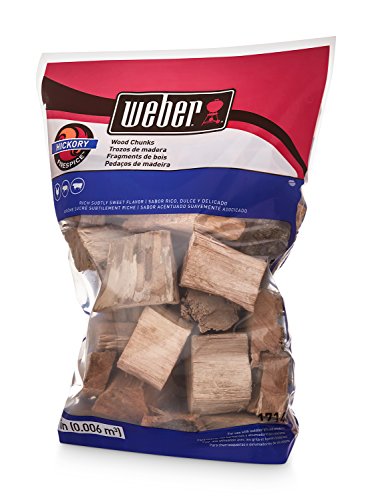
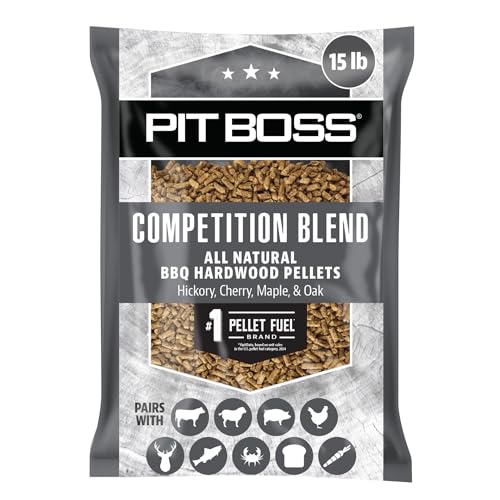

How should you store wood chunks, chips and pellets?
Pellets are the fragile one and it is not close. Because they are held together by nothing but compressed lignin, absorbed moisture makes them swell, lose structure and revert to damp sawdust. A bag left on a concrete garage floor over a wet season will wick moisture straight up through the plastic, and concrete is far more effective at that than people expect. Tip pellets into an airtight bucket with a gasket lid the day the bag arrives and the problem disappears.
Dead pellets are easy to spot once you know the signs. The bag has an unusual amount of fine dust in the bottom. Individual pellets crumble between finger and thumb instead of snapping. They look swollen or furry rather than smooth and glossy. Any of those and they belong in the garden, not the hopper, because damp pellets are a mechanical problem rather than a flavour one: they bridge in the hopper, jam the auger and starve the burn pot, which reads on the controller as a temperature swing or a flameout at three in the morning. Empty the hopper if the grill will sit for weeks, and never leave pellets in it through a wet spell.
Chunks and chips are far more forgiving. They want the same thing a firewood stack wants: dry, ventilated and off the ground. A sealed plastic tub is actually the wrong container for wood that went in slightly damp, because it traps moisture and grows mould. An open crate under cover is better. Wood that has gone mouldy or that shows white fungal growth should not go in a cooker, and neither should anything painted, treated, pressure treated, stained or salvaged from a pallet. Cook only with clean hardwood sold for cooking, and never with softwoods like pine, which carry resins that taste terrible and burn dirty.
What is a smoke tube and do you need one?
A smoke tube is a perforated stainless tube, usually 6 or 12 inches long, that you fill with pellets, stand on the grate, and light at one end with a torch. It smoulders from that end inward like an enormous incense stick, and a 12 inch tube runs roughly 4 to 5 hours on one fill. It needs no power, no modification and no permission from the cooker.
That makes it the standard fix for the most common complaint about pellet grills, which is that the smoke is too polite. A pellet grill holding 225°F is running an efficient, nearly clean fire, and efficiency and heavy smoke are opposites. Adding a lit tube on the grate gives you a second, deliberately inefficient smoke source that does not touch the controller or the temperature. It also turns any cooker into a cold smoker: a tube in an unlit gas grill or electric cabinet will smoke cheese, nuts, salt or fish without meaningfully heating the chamber.
Two cautions. Cold smoking anything perishable is a food safety question rather than a technique question, because the chamber sits squarely in the 40°F to 140°F danger zone the entire time, and cured products require a curing salt used at an exact rate rather than improvisation. And a tube left burning for a full brisket cook is one of the few reliable ways to over-smoke on a pellet grill. Run it for the first three or four hours and let it die.
How much wood is too much?
Over-smoking is real, it is unmistakable, and it is permanent. The flavour is sharp, bitter and faintly chemical, closer to a cold ashtray than to barbecue, and no sauce fixes it. It comes from creosote and unburnt particulates condensing onto a cool, moist meat surface, which is precisely what a smouldering, air-starved fire produces in quantity.
The practical numbers: two to four fist-sized chunks on a long charcoal cook, not a dozen. About a cup of chips at a time in an electric cabinet, and only in the first few hours. One tube of pellets, not a tube refilled all day. Meat takes on smoke most readily while the surface is still cool and moist, and adhesion falls away sharply once the bark dries and sets, so wood added at hour eight is mostly just fuel.
The other half of the problem is airflow. A choked cooker with the exhaust half shut traps stale smoke against the food and produces the same acrid result from a perfectly reasonable amount of wood. The top vent stays fully open, always, and you meter the fire from the intakes underneath. That principle is the backbone of the temperature control guide, and it matters more to the taste of your food than which species you bought.
Who should pick which format?
Sorted by what you actually own, because the cooker decides most of this before preference gets a say.
- You burn charcoal in a bullet, drum or kettle: chunks, buried in the unlit charcoal at the start. Two or three of them, one species, and no refills. A four pound bag of hickory chunks covers several long cooks.
- You run an electric cabinet with a side chip loader: chips are genuinely right here, because the loader removes the door-opening penalty that makes them a nuisance everywhere else. Use them in the first three hours only.
- You run an electric cabinet with no loader: chunks in the tray, so you are not opening the door every twenty minutes and losing your chamber heat.
- You own a pellet grill: pellets, obviously, and treat the bag price as a running cost rather than a one-off. Start with a house blend, and add a smoke tube if you decide you want more smoke rather than switching to an expensive bag.
- You want the heaviest smoke you can get: whole-log pellets in a tube on top of chunks in a charcoal cooker. This is also the fastest route to over-smoking, so change one thing at a time and taste before you escalate.
- You are cold smoking cheese, nuts or salt: a pellet tube in an unlit cooker. No other format does this job without adding heat.
Who should not buy pellets or a bag of chips?
Do not buy expensive competition pellets as your first bag. A whole-log pellet at roughly twice the price of a house blend is a heavier smoke profile you have not yet decided you want, and heavy smoke on a twelve hour cook is the fastest route to an acrid brisket. Learn your cooker on the cheap blend, then spend up once you can articulate what you want more of. The pellet roundup makes the same argument at more length.
Do not buy chips at all if you cook on charcoal. They are stocked next to the charcoal in every hardware store, which is why people buy them, and they are the wrong format for that cooker. Twenty minutes of smoke per handful means a day of lifting the lid, and every lift costs you fifteen minutes of recovery, so the chips actively lengthen your cook while delivering less smoke than two chunks would have.
Do not buy pellets for a charcoal or electric smoker unless you also buy the tube. Loose pellets on a charcoal bed flare, burn out fast and can spike your chamber temperature. They are a metered fuel and they need a device that meters them.
And do not buy a pellet grill for the smoke flavour alone. If maximum smoke is genuinely your priority, a charcoal cooker with chunks delivers more of it for a fraction of the money. Pellet grills win on convenience, repeatability and unattended overnight cooks, which is a strong case, just not the one about flavour. The pellet grill versus offset smoker comparison works through that trade honestly.
The verdict
Chunks are the default for charcoal and for electric cabinets, because one piece covers an hour and two or three cover the part of the cook where smoke actually adheres. Pellets are not optional if you own a pellet grill, since they are the fuel, and their real decision is blend versus whole-log rather than format at all. Chips are a niche format for short cooks and side-loading cabinets, and outside that niche they are the format most people waste money on.
Whichever you buy, the fire matters more than the shape of the wood. Clean thin blue smoke from a well-vented fire tastes better than heavy white smoke from any format, at any price, in any species. Get the airflow right first and the wood becomes a seasoning decision, which is all it was ever supposed to be.
Related pages
- Wood flavour chart for strength and pairing by species
- Wood pairing guide for which wood suits which meat, and which to avoid
- Pellet usage calculator to size a hopper load for your cook and your weather
- Pellet consumption chart for burn rates at every grate temperature
- Best wood pellets for the blends worth buying
- Water pan versus no water pan for the other big chamber variable