Skip to content
SmokerCalc
Menu

Best BBQ Gloves in 2026: Heat Ratings, Certifications and Cuff Length

Updated 2026-08-14 Researched, not tested in person
Quick answer

The Grill Armor EN407 Certified Heat Resistant Oven Gloves at $29.95 are the best BBQ gloves for most cooks, because the aramid fibre is rated to 932F with an independent certification behind the claim and the individual fingers let you work a damper without taking them off. Add disposable food-handling gloves at $22.67 for anything that touches cooked meat.

Gloves are the only genuinely protective equipment in barbecue, and most people buy the wrong thing because the category hides two completely different products under one name. One set protects you from the cooker. The other protects the food from you. You need both, they cost very little together, and using one for the other job is how people end up with a grease-soaked glove that fails in the heat and a pulled pork with a cross-contamination problem.

Three picks below covering the three jobs: handling cooked meat with your hands, working grates and vents, and reaching past an open flame. All three are compared on published heat ratings, materials, certifications and verified owner reviews rather than on personal use.

Best BBQ gloves by job

Beginner Best for handling meat
ANBOSON Disposable BBQ Gloves for Cooking and Grilling
ANBOSON

ANBOSON Disposable BBQ Gloves for Cooking and Grilling

$22.67

These are food-handling gloves, not fire gloves. Worn under a cotton liner they let you pull pork by hand and then throw the mess away, which is the single most useful glove trick in barbecue.

Best for: Pulling pork, trimming brisket, and keeping raw-meat contamination off everything you touch.

Check price
Intermediate Best all round
Grill Armor EN407 Certified Heat Resistant Oven Gloves with Fingers
Grill Armor Gloves

Grill Armor EN407 Certified Heat Resistant Oven Gloves with Fingers

$29.95

Aramid fibre rated to 932F with an EN407 certification behind the claim, and individual fingers so you can actually work a damper. The certification is the reason to prefer these over an uncertified glove making the same number up.

Best for: Moving grates, adjusting vents, and handling a hot water pan.

Check price
Expert Best for live fire
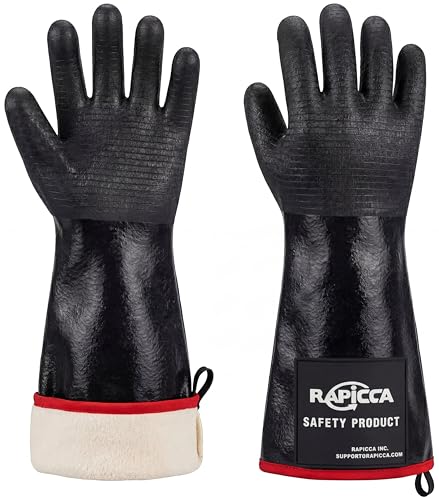
RAPICCA 17 inch Extra Long Neoprene BBQ Grill Gloves
RAPICCA

RAPICCA 17 inch Extra Long Neoprene BBQ Grill Gloves

$35.99

A 17 inch cuff protects the forearm, which is where offset cooks actually burn themselves reaching into a firebox. Neoprene also resists grease and wipes clean rather than absorbing it like cotton.

Best for: Offset and drum cooks reaching past an open flame, and anyone handling a charcoal chimney.

Skip it if: Anyone who mainly runs a pellet grill or electric smoker. There is no open firebox to reach into, the long cuff gets in the way, and the thick neoprene costs you the dexterity you need for probing. The fingered aramid glove is the better tool there.

Check price

Prices change often, confirm on Amazon. As an Amazon Associate we earn from qualifying purchases.

What heat rating do you actually need?

Far less than the box implies for most tasks, and more than you would guess for one. Moving a grate at 250°F, lifting a water pan or opening a door is a low temperature contact job. The number that matters there is not the peak rating, it is how long the glove protects you at that temperature, because heat resistance is always a function of contact time.

The exception is a charcoal chimney and a live firebox. A chimney of lit briquettes radiates hard, the handle is hot, and you are lifting a heavy object with an open top. That is where a high rating and a long cuff earn their money, and it is the job people hurt themselves doing.

Glove types compared by job. Ratings are manufacturer published figures and always assume brief contact rather than sustained holding.
Type Typical rating Cuff Dexterity Right job
Disposable nitrile over cotton liner Warm only Wrist Excellent Pulling pork, trimming, saucing
Aramid fibre, fingered Up to 932°F Short to mid Good Grates, vents, hot pans, general work
Neoprene coated, long cuff Around 500°F 17 in Moderate Firebox, chimney, wet and greasy work
Silicone Brief contact only Short Moderate Wet grabs, water pans, easy cleaning
Leather welding glove High radiant 14 to 18 in Poor Live fire only, never food contact

Why does the certification matter more than the number?

Any manufacturer can print 932°F on a package. EN407 is a testing standard that assesses a glove against defined thermal risks: contact heat, convective heat, radiant heat, small splashes of molten metal, and how the material behaves when it burns. A certified glove has been through that assessment. An uncertified glove quoting the same figure has been through a marketing meeting.

That is the whole reason the aramid glove sits in the middle tier here rather than the cheapest one. It is not the highest rated glove on the page, it is the one whose rating means something, and it happens to be the right shape for the work.

Why do you need a second, disposable pair?

Because heat gloves cannot be decontaminated. Aramid and leather both absorb grease and juices, neither washes to a food-safe standard between cooks, and a glove that touched raw meat before it touched a grate is a route for bacteria to travel around your cook. Disposable food-handling gloves solve this by being thrown away.

The practical version is a cotton liner glove with a disposable nitrile glove pulled over the top. The liner buys you enough insulation to handle a 200°F pork butt for the seconds it takes to move it, and the disposable layer keeps the mess and the contamination on something you bin. It is the single most useful glove habit in barbecue and it is why the beginner tier here is a box of disposables rather than a heat glove.

Who should not buy the long neoprene gloves?

Anyone whose cooker does not have an open fire in it. The 17 inch RAPICCA gloves are in the expert tier because forearm protection genuinely matters when you are reaching into an offset firebox or lifting a loaded charcoal chimney, and the neoprene wipes clean instead of soaking up grease like cotton does.

  • Skip them if you run a pellet grill or an electric smoker. There is no firebox to reach into, so the protection you are paying for never activates.
  • The long cuff gets in the way of ordinary work: it catches on grate handles, on hopper lids and on the cabinet door frame.
  • Thick neoprene costs you dexterity, which matters every time you pick up a probe or open a vent by a quarter inch.
  • Buy the fingered aramid glove instead if your cooking is controller-based. It is the better tool for that machine, and it is cheaper.

If you do run an offset or a charcoal cooker, reverse that advice entirely. The forearm is where offset cooks actually get burned, not the palm.

How should you look after them?

Wash aramid gloves in warm water with mild detergent and air dry them completely, following whatever the manufacturer says over anything you read online. Avoid bleach and avoid high heat tumble drying, both of which degrade heat-resistant fibres. Inspect for thin spots and burn marks, and retire a glove that has a hole in it rather than working around it.

Store them somewhere dry, not in the smoker and not draped over a warm firebox. A glove that has been sitting in a damp shed all winter is a glove with water in the fibre, which is exactly the failure described above. Clean the cooker on the same schedule using our smoker cleaning guide, because a grease-loaded cooker is its own fire risk.

Related reading

Frequently asked questions

What are the best BBQ gloves?

For most people the Grill Armor EN407 certified gloves at $29.95, because the aramid fibre is rated to 932F and there is an independent certification behind the number rather than a marketing claim. Individual fingers matter more than they sound: you cannot work a damper or pick up a probe wearing mitts, so a glove you have to take off constantly is a glove you stop wearing.

Do I need heat gloves and food gloves, or just one pair?

Both, and they cost very little together. Heat gloves protect you from grates, chimneys and fireboxes but should never touch cooked food, because they absorb grease and cannot be washed properly between cooks. Disposable food-handling gloves let you pull pork and trim brisket, then go in the bin with the contamination. Wearing a disposable glove over a cotton liner is the standard trick for handling hot meat.

What does an EN407 rating actually mean?

EN407 is a European standard for thermal risk in protective gloves, tested for contact heat, convective heat, radiant heat, small splashes of molten metal and burning behaviour. A certified glove has been assessed against defined tests rather than simply printing a temperature on the packaging. It is the single clearest way to separate a glove with a real rating from one making the same number up.

Can I use welding gloves for barbecue?

You can, and plenty of offset cooks do, but understand the trade. Welding gloves are built for radiant heat and spatter, with long cuffs and thick leather that give excellent forearm protection and poor dexterity. Leather also absorbs grease and cannot be washed, so it must never contact food. If you want one glove for a firebox, a welding glove is defensible. It is a poor choice for anything delicate.

Are silicone BBQ gloves any good?

They are waterproof and easy to wipe clean, which is genuinely useful when you are handling a wet water pan or a greasy grate. What they are not is highly heat resistant for long contact: silicone transfers heat faster than aramid over more than a few seconds, so they suit brief grabs rather than holding a hot grate while you reposition it. Check the rating, and do not assume it is high.

How do you clean BBQ gloves?

Follow the manufacturer instructions, because heat-resistant fibres can be damaged by bleach and high heat drying. Aramid gloves generally wash in warm water with mild detergent and air dry fully. Never put damp gloves near a fire or a hot grate: trapped water turns to steam on contact with heat and scalds through the fabric far faster than dry fibre would. Dry gloves are safer gloves.

How we choose gear: we compare published manufacturer specifications, capacity and temperature ranges, materials, warranty terms and verified owner reviews. We do not test gear in person and we do not publish hands-on claims we cannot support.

Cook times and temperatures are researched guidance, not a food-safety authority. Every figure on this page is an estimate: smokers, ambient weather, humidity and the individual cut all move it. Food is safe when a calibrated instant-read thermometer says so, never when a clock or a chart does. Keep food out of the 40°F to 140°F danger zone, observe the 4 hour rule, and follow current USDA safe minimum internal temperatures. If you are cooking for anyone pregnant, very young, elderly or immunocompromised, cook to the USDA minimums rather than to a preference-based doneness temperature.