Best Charcoal Smoker in 2026: Bullets, Cabinets and Drums Compared
Charcoal is the fuel that made barbecue, and it is still the cheapest route to the flavour people are actually chasing. A charcoal smoker has no controller, no motor and no power cord, which means it has almost nothing to break and nothing to fail at 3am. What it asks in return is that you understand two things: how much fuel you loaded and how much air you are letting reach it. That is the entire skill.
Three picks below at genuinely different budgets, plus three more cookers that solve adjacent problems: a small bullet, a hanging drum and a gravity-fed cabinet with a digital controller. Everything here is compared on published specifications, materials and verified owner reviews. We have not cooked on any of them in person.
Best charcoal smokers by experience level


Why is the bullet smoker still the reference design?
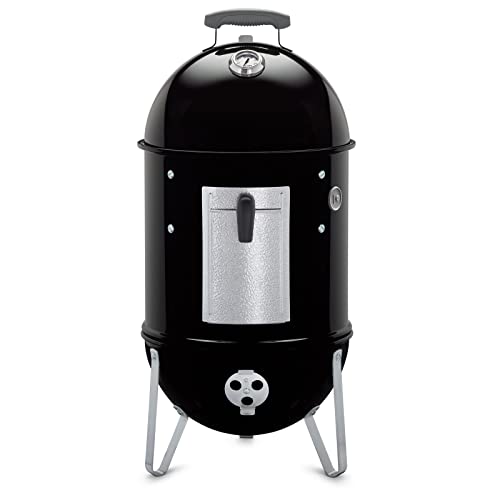
A bullet is three sections stacked vertically: a charcoal ring at the bottom, a water pan in the middle, and two grates above it under a domed lid. That layout does something clever. The charcoal ring burns from the outside inward rather than all at once, so the fire feeds itself slowly for hours, and the water pan sits directly between the fire and the food acting as both a heat shield and a thermal buffer.
The result is a cooker that is unusually hard to knock off temperature. It is also almost entirely passive, which matters more than it sounds: a passive cooker has no failure mode beyond running out of fuel. Fifteen years later the same smoker is still working, and the replacement parts still exist.
What does the water pan actually do?
Two separate jobs, and it is worth separating them. First, thermal mass: a gallon of water cannot exceed 212°F, so it absorbs energy from a spike and gives it back when the fire dips. Second, humidity: a humid chamber slows the surface of the meat drying out, which helps smoke adhere early and makes bark form more evenly.
Both come at a price. The humidity that helps early also feeds the evaporative cooling that causes the stall, so a water pan lengthens a long cook, and it keeps the bark softer than a dry chamber does. Plenty of experienced cooks foil the pan and fill it with sand instead, keeping the mass and losing the humidity. Our water pan versus no water pan comparison lays out when each is right.
Which charcoal should you burn?
| Fuel | Burn per load | Peak temperature | Stability | Best for |
|---|---|---|---|---|
| Standard briquettes | 8 to 12 h | Around 600°F | Very steady, uniform size | Overnight brisket and pork butt |
| Lump hardwood | 4 to 7 h | 900°F and up | Variable, piece size differs | Hot and fast, poultry, searing |
| Briquettes plus wood chunks | 8 to 12 h | Around 600°F | Steady with smoke pulses | The standard low and slow setup |
| Charcoal with wood chips | 8 to 12 h | Around 600°F | Steady, smoke lasts 20 min | Short cooks only, refill often |
Charcoal is heat, wood is flavour. That division is the thing most new cooks get wrong: they buy an expensive lump expecting a smoke profile and get an expensive fire. Add two or three fist sized chunks of hardwood to a briquette load and you have the classic setup. See the wood pairing guide for which species goes with which meat, and chunks versus chips versus pellets for why chips are the wrong format here.
How do you hold 225°F without a controller?
Light a small portion of the ring and let it spread. The standard method is the minion approach: fill the charcoal ring with unlit briquettes, bury a few wood chunks in it, then pour roughly fifteen to twenty lit coals from a chimney on top. The lit coals ignite their neighbours slowly and the fire creeps outward for hours instead of igniting all at once.
From there, the top vent stays fully open, always. It is not a control, it is the exhaust, and choking it traps moisture and stale smoke against the meat, which is what makes food taste acrid. All metering happens at the bottom intakes.
| Target grate temperature | Bottom vents open | Top vent | Typical use |
|---|---|---|---|
| 225°F | About 25 percent | 100 percent | Brisket, pork shoulder |
| 250°F | About 40 percent | 100 percent | Ribs, most cooks |
| 275°F | About 60 percent | 100 percent | Hot and fast, poultry pieces |
| 325°F and up | 100 percent | 100 percent | Whole chicken for crisp skin |
Move one vent at a time and then wait twenty minutes. Charcoal responds slowly, and almost every temperature disaster is a cook making a second adjustment before the first one landed. It is far easier to bring a cooker up than to bring it down, so start closed and open into the target. The full method is in the temperature control guide.
Who should not buy the 22 inch?
Anyone cooking for a household. The Weber Smokey Mountain 22 inch is the expert pick because it lays a full untrimmed packer flat with room for a second one above it, and that is a genuine advantage if you cook for crowds. For everyone else it is the wrong buy, and not by a small margin.
- It burns noticeably more charcoal to hold the same temperature, on every cook, whether it is full or not.
- It is harder to control half empty than a full 18 inch, because the larger chamber has less food acting as thermal mass.
- Capacity you do not use costs money forever. The fuel penalty is not a one-time purchase price, it is a running cost.
- Buy it when you have actually run out of room on an 18 inch more than once, not in anticipation of a party you have not scheduled.
If anything, most households would be better served by going the other direction. The 14 inch bullet below is genuinely fuel efficient, fits on a balcony, and travels. Check your real headcount with the smoker size calculator before you assume bigger is better.
What about drums and gravity-fed cabinets?
Charcoal is not only bullets. A hanging drum runs hotter, around 275°F to 310°F, and suits ribs and chicken better than a long low brisket. A gravity-fed cabinet feeds charcoal from a hopper with a fan and a digital controller, giving you charcoal fuel with pellet-grill convenience at a price that reflects it.
Also worth knowing about


What do you need to buy alongside it?
A charcoal chimney, which lights coals with newspaper in about fifteen minutes and removes lighter fluid from your food entirely. A dual-probe thermometer, because the lid gauge reads dome temperature rather than grate temperature and is commonly well out. A cover, because water sitting in a charcoal bowl rusts it from the inside. Then read how to smoke ribs, which is the cook a bullet does best and the one worth learning first.
Related reading
- Electric versus charcoal smoker: the honest trade in both directions
- Best smoker under $500: the cross-category view of the same budget
- Smoking time and temperature chart: planning figures for every cut
- All gear guides