Best Pellet Grill in 2026: Controllers, Capacity and Fuel Cost Compared
A pellet grill is an outdoor convection oven that happens to burn wood. That framing explains both why people love them and why some people are disappointed: you get a set-and-forget controller and a temperature line that looks like a line, and you give up some of the heavy smoke a charcoal fire produces. If that trade suits you, the important specs are the controller type, the grate area and whether the body is insulated. Everything else on the box is noise.
Below are three picks at genuinely different levels of commitment, plus three more cookers worth knowing about at the edges of the category. Prices and capacities come from current published listings and manufacturer specifications, and we have not cooked on any of them in person: this is a specification and owner-review comparison, not a hands-on test.
Best pellet grills by experience level


How many square inches of grate do you actually need?
Capacity is the spec people overbuy hardest, because square inches are cheap to print on a box and expensive to store on a patio. The number that matters is not the headline total, it is how much of that area is primary grate rather than a warming rack you cannot fit a pork butt on. A 550 square inch cooker with one usable level holds more real food than an 800 square inch cooker where 250 of those inches sit four inches below the lid.
The rough mapping below is what those areas hold in practice. A full packer brisket needs about 18 by 10 inches of flat space before it shrinks, which is why briskets are the cut that actually decides your capacity. If you never cook a whole packer, you need much less grill than the category assumes.
| Grate area | Rib racks | Pork butts | Whole chickens | Brisket | Feeds |
|---|---|---|---|---|---|
| 250 to 300 sq in | 2 | 1 | 2 | Flat only, trimmed | 2 to 4 |
| 450 to 600 sq in | 3 to 4 | 2 | 4 | One packer, diagonal | 6 to 10 |
| 800 to 900 sq in | 5 to 6 | 4 | 6 | One packer plus sides | 12 to 20 |
| 1,600 sq in and up | 10 or more | 8 | 12 | Two packers flat | 30 or more |
Run your own headcount through the meat yield calculator before you shop, because raw weight and served weight are not the same number. A pork shoulder loses roughly 40 percent of its raw weight to fat, bone and moisture, so twelve pounds of butt does not feed twelve people twelve portions.
What does a PID controller change on a long cook?
Every pellet grill works the same way: an auger drops pellets into a burn pot, a hot rod lights them, and an induction fan turns that into convection heat. The difference between a good cooker and a frustrating one is entirely in how the auger is told when to feed.
A simple timed controller runs the auger on a fixed duty cycle for a given setting. It has no idea what the grate is doing, so the chamber overshoots, coasts down, overshoots again, and your temperature line looks like a saw blade. A PID controller reads the actual temperature, compares it to the target, and adjusts feed rate continuously. In practice that is the difference between holding 225F within a few degrees and swinging 40, and swings are what make a twelve hour cook finish two hours off your estimate.
Both cookers in the beginner and intermediate tiers here run PID control. If you are comparing something else, that is the first spec to check, and a listing that will not tell you is telling you. Our temperature control guide covers what to do when the controller is fine and the cooker still will not settle.
How much fuel will you actually burn?
Pellets are the running cost, and people underestimate them badly on the first winter. Burn rate scales with how hard the fire has to work, which means it scales with target temperature, ambient temperature, wind and whether the body is insulated.
| Grate temperature | Pellets per hour | 12 hour cook | Cost at $1.20 per lb |
|---|---|---|---|
| 180°F smoke | 0.5 lb | 6 lb | $7.20 |
| 225°F | 0.8 lb | 9.6 lb | $11.52 |
| 250°F | 1.0 lb | 12 lb | $14.40 |
| 350°F | 2.0 lb | 24 lb | $28.80 |
| 450°F sear | 3.0 lb | 36 lb | $43.20 |
Work your own cook with the pellet usage calculator, and see the pellet consumption chart for the same figures broken out by cooker size. The practical rule is simple: keep a full spare bag. A hopper that runs dry at 3am does not just stop cooking, it drops the fire out and leaves a large piece of meat sitting in a cooling chamber.
Who should not buy the expert tier?
Almost everyone. The Traeger Ironwood 885 is a genuinely better cooker than the two below it, and for most readers it is the wrong purchase. Its advantage is double-wall insulation, and insulation only pays for itself if you cook in cold weather often enough to notice. If you fire the grill six to ten times a year in mild conditions, 885 square inches sits mostly empty and you have spent roughly $600 more than the Camp Chef for a feature your climate never activates.
The honest version of the upgrade path is that the money is better spent elsewhere first. A calibrated thermometer changes more cooks than any grill upgrade, and a year of good pellets plus a proper cover costs a fraction of the difference and extends the life of whatever you own. Buy the expert tier when cold-weather cooking or headcount has genuinely outgrown your current cooker, not before.
What else is worth knowing in this category?
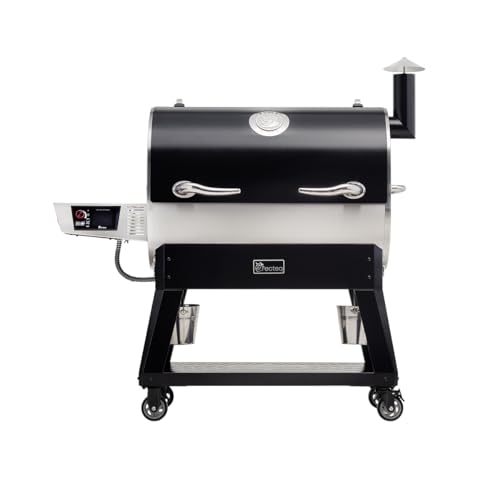
The three cookers below sit at the edges: one is competition and catering capacity, one is a tailgate box that will never hold a brisket, and one is a low-cost full-size unit with an included probe. None of them is the right default, and all three are the right answer for somebody.
Also worth knowing about


Is a pellet grill the right category for you at all?
Pellet grills win on convenience and consistency and lose on smoke intensity and searing. If what you want is the heavy, layered smoke of a wood fire and you enjoy tending one, an offset will make you happier and cost less to buy. If what you want is to put a pork butt on at midnight and sleep, a pellet grill or an electric cabinet is the correct tool and no amount of forum opinion changes that.
Read pellet grill versus offset smoker before you commit, and if this is your first cooker, work through the first smoker buying order so the thermometer and the fuel are budgeted alongside the grill rather than after it.
Related reading
- Best smoker under $500 for the cross-category view of the same budget
- Best wood pellets for what to actually burn in it
- How to smoke a brisket for the cook that decides your capacity
- All gear guides